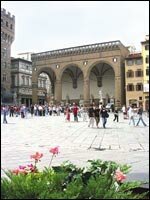
Piazza della Signoria |
PIAZZA DELLA SIGNORIA
This area is mainly characterised by the lively Piazza della Signoria, centre of power in Florence since the 1300 and that looks like an open-air museum. Some of the statues in the square, which commemorate the most important city events, are not the original ones. For example, the original Michelangelo’s David statue was moved in 1873 into the Accademia Gallery.
|
PALAZZO VECCHIO
The square Piazza della Signoria is dominated by the medieval Palazzo Vecchio built by the Guelfs in 1299 as the government building. Designed by Arnolfo di Cambio, it was completed in 1322 when an enormous bell was erected on the top of the tower. The interior was rebuilt in 1540 by Vasari when Cosimo I de’ Medici moved into the palace. In front of the Palazzo Vecchio stands the imponent Neptune Fountain. |
LOGGIA DEI LANZI

Loggia dei Lanzi |
A distinctive part of the Piazza della Signoria is characterised by the impressive Loggia dei Lanzi that was built between 1376 and 1391 by Benci di Cione and Simone Talenti, for cerimonial and official events for the “Signoria” and the townspeople. The late Gothic style used for the construction of this Loggia is very elegant. On the sides of the stairs, stand two lions, one is by Flaminio Vacca (1600). The interior houses prestigious sculptures like the famous “Perseo” by Cellini (1553) and the “Ratto delle Sabine” by Giambologna (1583).
|
UFFIZI GALLERY
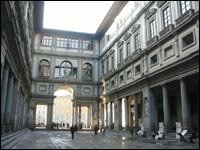
Uffizi Gallery |
We lively suggest a visit to the Uffizi Gallery, founded in Florence in 1581, by the De Medici family, one of the oldest museums in the world. The U-shaped Uffizi Palace, which covers an area of about 8.000 sq.m., houses the most important collection of paintings in Italy (with works by Botticelli, Leonardo da Vinci, Uccello etc..) and one of the most important collections of art of all times.
|
CORRIDOIO VASARIANO

Corridoio Vasariano |
The famous corridor (Corridoio Vasariano) that was used by the Medici to move from a residence to an other without leaving the house, was built in 1565 by the favourite Medici’s architect: Vasari. It connects the Palazzo Vecchio with Palazzo Pitti, through the Uffizi and Ponte Vecchio.
|
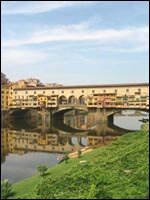
Ponte Vecchio |
PONTE VECCHIO
Ponte Vecchio is the oldest and the most romantic bridge which crosses the river Arno. It dates back to Roman times and it has often been re-built. It was the only one to survive to the second world war. Originally the sides held food shops but by the end of the 15th century Ferdinando I drove away these categories and the shops were assigned to goldsmiths and silversmiths. In the middle of the bridge there is a bust of Benvenuto Cellini, one of the most famous city’s goldsmiths.
|
DANTE'S HOUSE
Other interesting Museum of this area is the Dante’s House. The Dante’s House was restructured in 1911 and houses a Museum dedicated to Dante’s life and works. The ground floor of this house is used to organize modern art and sculpture exhibitions. |
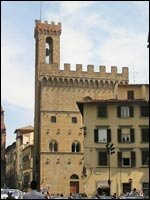
Bargello |
BARGELLO
The Bargello was built in 1255 and it is one of the oldest seat of the government in Florence. In the sixteenth century it became the residence of the Bargello or head of police spies from which it took its name. Throughout the XVIII century it functioned as a prison, in which were organized the capital executions until 1786. It has been the setting of many of the most important events of civic life. In 1865 it became one of the first National Museum housing some of the masterpieces of the Tuscan Renaissance and a superb collection of sculptures with works by Michelangelo, Donatello, Giambologna, Cellini and Andrea della Robbia. Interesting are the two Churches Orsanmichele and Badia Fiorentina.
|

Orsanmichele |
ORSANMICHELE
Orsanmichele since the VIII century, hosted the Oratory of San Michele in Orto. In 1290 Arnolfo di Cambio built a loggia to serve as the grain market, but in 1337 it was transformed into a church. On the exterior of the chapel marble tabernacles were built to host statues of the patron saints of the Guilds, who commissioned the greatest artists of the period. Thus we find Verrocchio's Saint John the Baptist and Doubting Thomas, Giambologna's Saint Luke, Donatello's bas-relief of Saint George freeing the King's Daughter, and a Madonna with Child by Luca della Robbia. Badia Fiorentina is one of the oldest in Florence and was found in 978 by Willa, the Count Uberto di Toscana’s widow. Their son, Ugo, was buried here in 1001 and his wonderful tomb was built by Mino da Fiesole between 1469 and 1481.The interior presents a beautiful painting by Filippino Lippi. Its cloister was built by Rossellino between 1435 and 1440 and is decored by many well preserved frescoes.
|