CHURCH OF SANTA CROCE
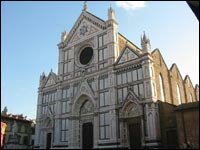
Santa Croce |
Piazza Santa Croce was the place in which the historical football match was played during the Carnival in 1530. Today, the statue of Dante (1865) has had to be shifted from the center to the side of the square to make way for the annual “calcio in costume” (football match in fancy dress) and here lies the magnificent gothic Church of Santa Croce, started by Arnolfo di Cambio in 1294 and finished in 1442. Its neo-gothic belltower was added in 1842. The interior presents frescoes by Giotto and his pupil Taddeo Gaddi. The church contains tombs and cenotaphs of important men including the ones of Michelangelo and Galileo. Machiavelli was buried here in 1527 and his funeral monument was erected in 1727 by Innocenzo Spinazzi.
|
CAPPELLA DE' PAZZI
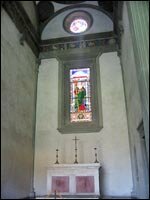
Cappella de' Pazzi |
In the cloister near the church, is the Cappella de’ Pazzi by Brunelleschi to be found, which is one of the masterpieces of the architecture of the Renaissance. This chapel was built in 1443 but finished in 1461, 15 years after Brunelleschi’s death and is characterised by an hemispherical dome, surrounded by Luca della Robbia’s terracotta roundels of the Evangelists. In the Museo dell’Opera di Santa Croce is exhibited the famous Crucifix by Cimabue which has now been restored after it was ruined by the floods in 1966. Donatello’s colossal bronze of St. Louis is also here, as is Orcagna’s “Triumph of Death”.
|
CASA BUONAROTTI
Interesting in this area is Casa Buonarroti: In 1508 Michelangelo bought this complex composed by three houses. Today, this house shows an important collection of Michelangelo’s works, including one of his first masterpieces: the “Madonna della Scala” (1490-92). |
MUSEUM HORNE
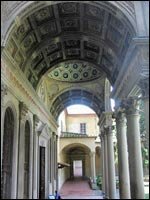
Museum Horne |
An important collection of paintings, sculptures and historic furnitures is housed in the Museum Horne, created by the English art historian Herbert Horne (1864-1916). The collection contains a fine “St. Steven” attributed to Giotto and also a book containing sketches by Tiepolo (XVIII century).
|
SYNAGOGUE
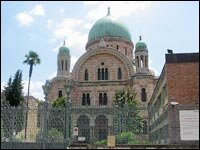
Synagogue |
The green dome of the of Florence’s Synagogue stands out on the horizon as you look down on the city from the surrounding hills. It was built by Marco Treves between 1874 and 1882 in the Spanish-Moorish style. Its dome and decorations look like the ones of a mosque. This Temple also houses a museum of ritual objects dating to the XVII century.
|
CHURCH OF SANT'AMBROGIO
The church of Sant’Ambrogio houses the tomb of sculptors Mino da Fiesole (1430-84) and Andrea Verrocchio (1435-88). The left side chapel contains a marble Tabernacle by Mino da Fiesole with terracotta angels from the Della Robbia school.; the façade can be seen on a processional fresco dating from 1486. The area is also characterised by the extended Giardino della Gherardesca, one of the most beautiful gardens in Florence. Originally it was the “Giardino Pinti” but at the beginning of 1600, Guido Alberto della Gherardesca changed its planning with the creation of an artificial lake and the plantation of tall trees. The architect Giuseppe Cacialli built the Ionic Temple that was decored by Antonio Marini. Beautiful peaces from the etruscan, roman, Greek and Egyptian era are housed in the Museo Archeologico that is located in a building dated 1620, built by Giulio Parigi for Princess Maria Maddalena de’ Medici. The Etruscan collection was badly damaged by the floods in 1966 and today only a small section of it can be seen. |