DAVANZATI PALACE
This central area between introduces you in the Florentine’s true life starting from the past, visiting the Museum of the Antique Florentine House in Palazzo Davanzati, built in the 14th century for the wealthy family of merchants Davizzi. Towards the end of 1570 the palace was handed over to the worshipper of art and literature Bernardo Davanzati, who wanted it to be the residence of the family as well as the headquarters of his business. In 1956, the palace was re-opened to the public as Museo della Casa Fiorentina Antica (The Museum of the Antique Florentine House). The museum represents the typical house of noblemen from Florence during the XVI century, and it contains a whole series of XIV century house-hold items. |
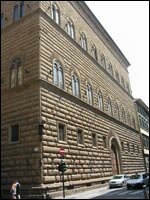
Strozzi Palace |
PALAZZO STROZZI
The well known Palazzo Strozzi is one of the symbols of Renaissance architecture. This imposing palace (the biggest in Florence), was commissioned by Filippo Strozzi who charged Benedetto da Maiano with planning a family residence that would be the envy of the Florentine nobility. The palace was built between 1489 and 1538, but remained without the southern facade. Its small Museum in the courtyard, shows the building’s history through drawings and models.
|
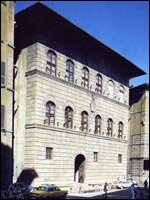
Antinori Palace |
ANTINORI PALACE
Other interesting building is located in this area: Palazzo Antinori, originally Palazzo Boni e Martelli, built between 1461 and 1466 and bought by the Antinori family in 1506. Still today the building is the property of the Antinori family, who, through time, has overseen restoration work, maintaining the building's age old splendor. With its elegant courtyard is one of the most refined palace of the Renaissance of Florence.
|
CORSINI PALACE
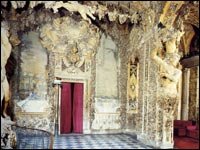
Corsini Palace |
Palazzo Corsini, built between 1648 and 1656 by the architects Pier Francesco Silvani and Antonio Ferri in grandiose Roman Baroque style. The Palace presents a façade crowned by statues and has a terrace overlooking the river. It is at the present day the seat of many events among which the annual Exhibit of Antiques.
|
RUCELLAI PALACE
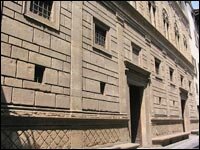
Rucellai Palace |
Palazzo Rucellai has been built between 1455 and 1458 and commissioned by Giovanni Rucellai, importer of a rare and expensive red colouring called “oricello”, from which the same name of Rucellai derives. The Palace used to house the Museo Alinari that exhibits pictures of Florence starting from 1852; now the collection has been moved to the so called Archivio Alinari, in Largo Fratelli Alinari 15.
|
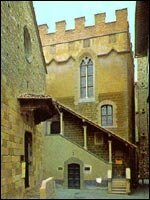
Palace of the Guelf Party |
PALACE OF GUELF PARTY
In the XIV century, was built the residence of the Captains of the Guelf Party: the Palazzo di Parte Guelfa based on a design by Brunelleschi. In its interior of artistic interest are the Sala dell'Udienza (or Sala dei Capitani) dating back to the beginning of the 15th century, and the Salone del Brunelleschi, which was subsequently altered by Vasari. Above one of the doors there is a Madonna with Child by Luca della Robbia.
|
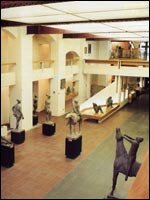
Museo Marino Marini |
MUSEO MARINO MARINI
Interesting in this area is the Churh of San Pancrazio, now Museo Marino Marini. The church of S. Pancrazio is one of the oldest church in Florence and dates back to the IX century; its façade and porch are by Leon Battista Alberti (1461-7). Inside there is the Rucellai’s tomb. The church was changed into a Museum devoted to Marino Marini -1901/1980- one of the most important abstract artist in Italy. His work is noted for rugged and elemental bronzes featuring hoses and riders.
|
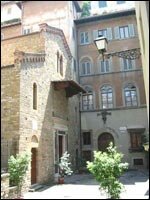
Santi Apostoli |
SANTI APOSTOLI
The charming church of Santi Apostoli is, together with the Baptistery, one of the oldest in Florence. Florentines believe that it was erected by Carlo Magno during the I century but it probably goes back to the second half of the XI century. The shape is the one of an early-christian basilica but the naves are of the XVI century. The interior is full of atmosphere with a fine painted timber shed roof on compound piers which articulate the church into three aisles. On the third altar of the right aisle is a panel with the Immaculate Conception by Giorgio Vasari (one of his best works).
|
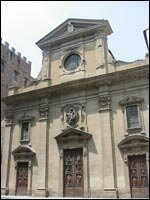
Church Santa Trinita |
CHURCH SANTA TRINITA
Another church worth of visiting in this area is Santa Trinita: the 11th-century original building was rebuilt and enlarged in the 13th and 14th centuries, on a project of Andrea Pisano, who remodelled a Vallombrosan convent that already stood on the site. During the centuries its appearance changed and in 1593 was added a Baroque facade. The linear facade in stone is by Buontalenti (1593). The interior presents frescoes by Ghirlandaio (1483-86).
|
MERCATO NUOVO
One of the symbols of Florence is the famous Mercato Nuovo built between 1547-1551 by Grand Duke Cosimo I. This market is locally known as the ‘Porcellino' (swine) because of the fountain by Pietro Tacca, 1612. Tradition want that everyone who rubs the wellpolished snout of Il Porcellino, is certain to return to the city. Coins dropped in the trough below are distributed to city charities. In the Mercato Nuovo, lace, straw-work, leather goods and souvenirs can be bought. |