DUOMO OF SANTA MARIA DEL FIORE
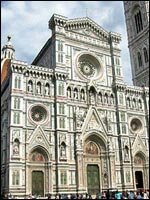
Duomo of Santa Maria del Fiore |
This area of Florence is dominated by the superb Duomo of Santa Maria del Fiore, the highest building of the city, one of the best-known symbol of the town that overlooks Florence with its enormous Dome. The Cathedral, dedicated to “Saint Mary of the Flower” is located in the beautiful Piazza del Duomo, designed by Arnolfo di Cambio who enlarged the existing structure. The building of the Duomo started in 1296. The Cupola remained unfinished and only in 1421 it was built by the famous architect Brunelleschi. The cupola’s interior was decorated by Giorgio Vasari and Federico Zuccari who painted a huge “Last Judgement”. The Bell tower, designed by Giotto in 1334, was completed in 1359, 22 years after his death. The work was continued under Andrea Pisano and Francesco Talenti who continued in repeating the marble decoration and the Ghotic ornamentation. The belltower (Campanile) is still a masterpiece of elegance.
|
BAPTISTERY
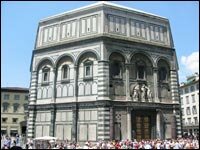
Baptistery |
The Baptistery of Saint Mary of the Flower is one of the oldest constructions of Florence and goes back to the IV century. The gilded bronze doors are by Andrea Pisano (present south door: 1336) and Lorenzo Ghiberti (north and east doors: 1427 and 1452). The latter is the famous "Gates of Paradise", whose original panels has been removed for restoration and there are copies in its place.
|
LOGGIA DEL BIGALLO
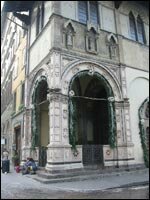
Loggia del Bigallo |
Many interesting sights are located in this area such as the great Loggia del Bigallo for instance, with its marble decorations is in a typical XIV century Gothic style. Originally, foundling children were left under the loggia: if after three days they were not claimed by their parents, they were sent to foster homes. The exhibits in its museum include the first known pictorial representation of Florence (1345) and a painted crucifix from an unknown artist that goes back to 1225-1235.
|
MUSEUM DELL'OPERA DEL DUOMO
The Museum dell’Opera del Duomo houses superb works taken from the Cathedral, the Baptistery and from the Belltower. Most of the statues were created to adorn the Cathedral and include works from Donatello and Nanni di Banco. One of the most famous sculpture in the world is housed in this Museum: the Michelangelo’s Pietà, brought here from the Duomo in 1981. |
MUSEUM OF FIRENZE COM'ERA
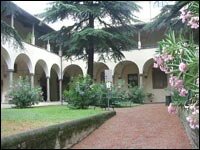
Museum of Firenze com’era |
The Museum of Firenze com'era shows Florence and its life through pictures, paintings, plans and prints starting from the XV century to today.
|
CHURCH OF SAN LORENZO

Church of San Lorenzo |
The area around the church of San Lorenzo and is deeply characterized by the founder of the Medici Family: Cosimo the Old. This church was consecrated in 393 by Saint Ambrose, Bishop of Milan. In 1418 the Medici decided to adopt it as their church of family and commissioned the task of renovating the building to Brunelleschi. After his death, Antonio Manetti continued his work and then, Michelangelo (1520 – 34) who added two sacristies, the Medici Chapels and the Biblioteca Medicea-Laurenziana. The Medici Chapels are attached to the San Lorenzo Basilica. This monumental complex comprises the Prince's Chapel and the New Sacresty. The Princes' Chapel with its wonderful polychrome marble decoration, is covered with a huge dome designed by Buontalenti The New Sacresty was begun by Michelangelo (1512) and completed by Vasari and Ammannati. It contains six tombs of Grand Dukes and elaborate designs in green and red marble. The Medici Tombs house Michelangelo's spectacular statues Night, Day, Dawn and Dusk. The Biblioteca Medicea Laurenziana (by Michelangelo), was founded by Cosimo the Old in 1524 to house the big collection of the ancient Medici’s manuscripts. This library contains a rich collection of medieval manuscripts and Renaissance editions of classic works.
|
PALAZZO MEDICI-RICCARDI
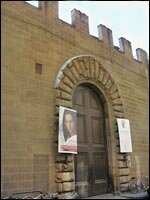
Palazzo Medici-Riccardi |
Talking about the Medici family, we would like to introduce theire residence from 1444 to 1544: Palazzo Medici-Riccardi, that became property of the Riccardi family since 1545. Today, this palace is the seat of the Prefecture. Cosimo the Old commissioned the construction to Michelozzo after the refusal of a Brunelleschi’s design. In 1517 Michelangelo added the windows on the sides of the entrance. Originally, the Donatello’s David was located here; today, his location is occupied by the marble sculpture of the Orpheus by Bandinelli. Cosimo I, from 1537 Duke of Florence, commissioned in 1540, Baccio Bandinelli, to build a mausoleum in memory of his father Giovanni de’ Medici, called Giovanni dalle Bande Nere. Cosimo wanted a monument worthy of the greatest military leader of the 16th century. Giovanni was represented seated, as though resting in death, holding in his right hand a broken lance.
|
CENTRAL MARKET
This area is also characterized by the Central Market, housed inside a large 18th century building, designed by Giuseppe Mengoni, with relatively modern green and red exterior. This is the Florence’s best food market, and it is located in the middle of the San Lorenzo street market. The Central market offers a great variety of flowers and food, from meats, fish, cheese and bread to olive oil, wine, and typical Tuscan take-away foods. Other historical buildings that you find in this area are Palazzo Salviati, the head-office of the Banca Toscana, with its frescoes that go back to the XIV century, Palazzo Nonfinito, started by Buontalenti in 1593 and never completed, with its beautiful courtyard attributed to Cingoli (1559- 1613) and Palazzo Pucci erected during the XVI century by Bartolomeo Ammannati, once residence of the Pucci family, historical allied of the Medici family. |