SAN MARCO'S CONVENT
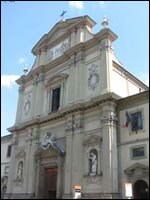
San Marco’s convent |
This area is characterized by the beautiful 13th century convent of San Marco that with its church, monastery and museum is one of the favourite places of art lovers. The San Marco’s convent was founded during the XIII century and enlarged in 1437 by Michelozzo, when Dominican Monks from nearby Fiesole moved here at the invitation of Cosimo the Old. The sober cloisters and the simple cells are the contest in which are located many beautiful frescoes by Beato Angelico (1438/45).
|
GALLERIA DELL'ACCADEMIA
Near the square is possible to visit the museum of the Galleria dell’Accademia that houses the famous original Michelangelo’s statue of David. The Florence’s Fine Arts Academy was created in 1563 and it was the first school to teach design, painting and sculpture.The collection here exposed was gathered in 1784 as material to copy and to study for pupils. Since 1873 many of Michelangelo’s works are housed in the Academy: the most important are the “David” (1504) and “San Matteo” (1508). Important are the paintings by Filippino Lippi, Bronzino, Rodolfo del Ghirlandaio (XV and XVI centuries). In this area you will also find the well-known Cenacolo di Sant’Apollonia, and the enchanting botanical garden (Giardino dei Semplici). |
SANT'APOLLONIA
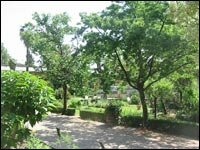
Sant’Apollonia |
Sant’Apollonia was a former convent and it is mainly characterised by the cloister and refectory. The main wall of the refectory is decorated with the famous fresco of Andrea del Castagno (1445-1450) and represents the “Ultima Cena” (Last Supper). Del Castagno was one of the first artists to study the perspective. The botanical garden, the Giardino dei Semplici, laid out by commission of Cosimo I in 1545, houses flowers from all over the world and close to it there are some specialized museums like the Museum of Mineralogy and the Botanical one (the most important in Italy).
|
OPIFICIO DELLE PIETRE DURE
Very interesting is a visit to the Opificio delle Pietre Dure: this Museum (Workshop of Hard Stones) contains hard stone masterpieces belonging to the Grand Dukes of Florence. Inside the newly-refurbished rooms, one can admire the amazing materials and craftsmanship of carvings, mosaics and hard stone furniture manufactured from 1588 to the end of the 19th Century by the workshop created by the Medici family especially for this purpose. The Museum also presents the collection of stones, the tools and information on the techniques behind these magical creations. |
PALAZZO PANDOLFINI
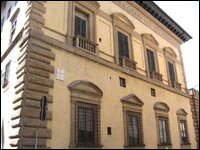
Palazzo Pandolfini |
Walking through this area, have a look to Palazzo Pandolfini, an excellent model of the civil architecture of the XVI century, it was built by the family of architects da Sangallo according to a project of Raffaello, in 1520.
|
CHIOSTRO DELLO SCALZO
Another beautiful sight of Florence is the well-known Chiostro dello Scalzo that was the entrance hall of the chapel belonging to the Compagnia dei Disciplinari of Saint John the Baptist - or Passion of Christ. It is called "dello Scalzo" (barefoot) because the friar holding the cross used to go barefoot. The Chiostro dello Scalzo really shows Andrea del Sarto's painting path: it is an absolute masterpiece in the constant dialogue of space, architecture and figures highlighted by the use of monochrome. All the artists of 1500 looked upon Sarto as an example. |
PORTA SAN GALLO
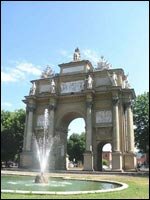
Porta San Gallo |
In Piazza della Libertà lies one of the oldest constructions of Florence: Porta San Gallo. This gate dates back to 1284. It was included in the fortification walls of Florence. It was modified substantially in XVIII the century when it came enriched for greeting the arrival of the new Granduca Francisco Stefano di Lorena. On the sides of the arch stand two stone lions.
|
OSPEDALE DEGLI INNOCENTI
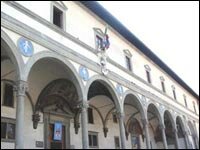
Ospedale degli Innocenti |
This area is mainly represented by the Ospedale degli Innocenti, the ancient foundling hospital were orphanages were recovered during the XV century. Remarkable the Brunelleschi’s arcaded loggia of the hospital, decored with terracotta roundels by Andrea della Robbia representing children in swadling bands. The porch in Piazza Santissima Annunziata was designed by Brunelleschi in 1419 and is the façade of the “Ospedale degli Innocenti”. In the centre of the square stands an equestrian statue featuring Duke Ferdinando I. The construction of this statue started by Giambologna but it was finished by his pupil, Pietro Tacca, in 1608, who built also the two bronze mannerist fountains.
|
CHURCH OF SANTISSIMA ANNUNZIATA
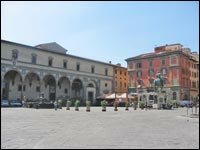
Santissima Annunziata |
The Church of Santissima Annunziata, located in the square, was born in 1250 and completely rebuilt by Michelozzo between 1444 and 1480. In the atrium there are frescoes by Rosso Fiorentino, Andrea del Sarto and Jacopo Pontormo (beginning XV century, XVI century). The interior is very dark and the ceiling is decorated with a fresco by Pietro Giambelli (1669). This site contains a famous relic: the fresco of the “Annunciazione” that legendary was started in 1252 by a monk and completed by an angel. In the cript is buried Benvenuto Cellini.
|
SANTA MARIA MADDALENA DE' PAZZI
Many churches and temples are located in this area: interesting is Santa Maria Maddalena de’ Pazzi. This ex-convent was restructured later on the 1966 flood. The “Sala del Capitolo” presents the famous fresco “Crocifissione con Santi” (Crucifixion) by Perugino (1493-96). The Major Chapel is the most interesting example of baroque decorations in Florence and it was designed by Ciro Ferri in 1675. |